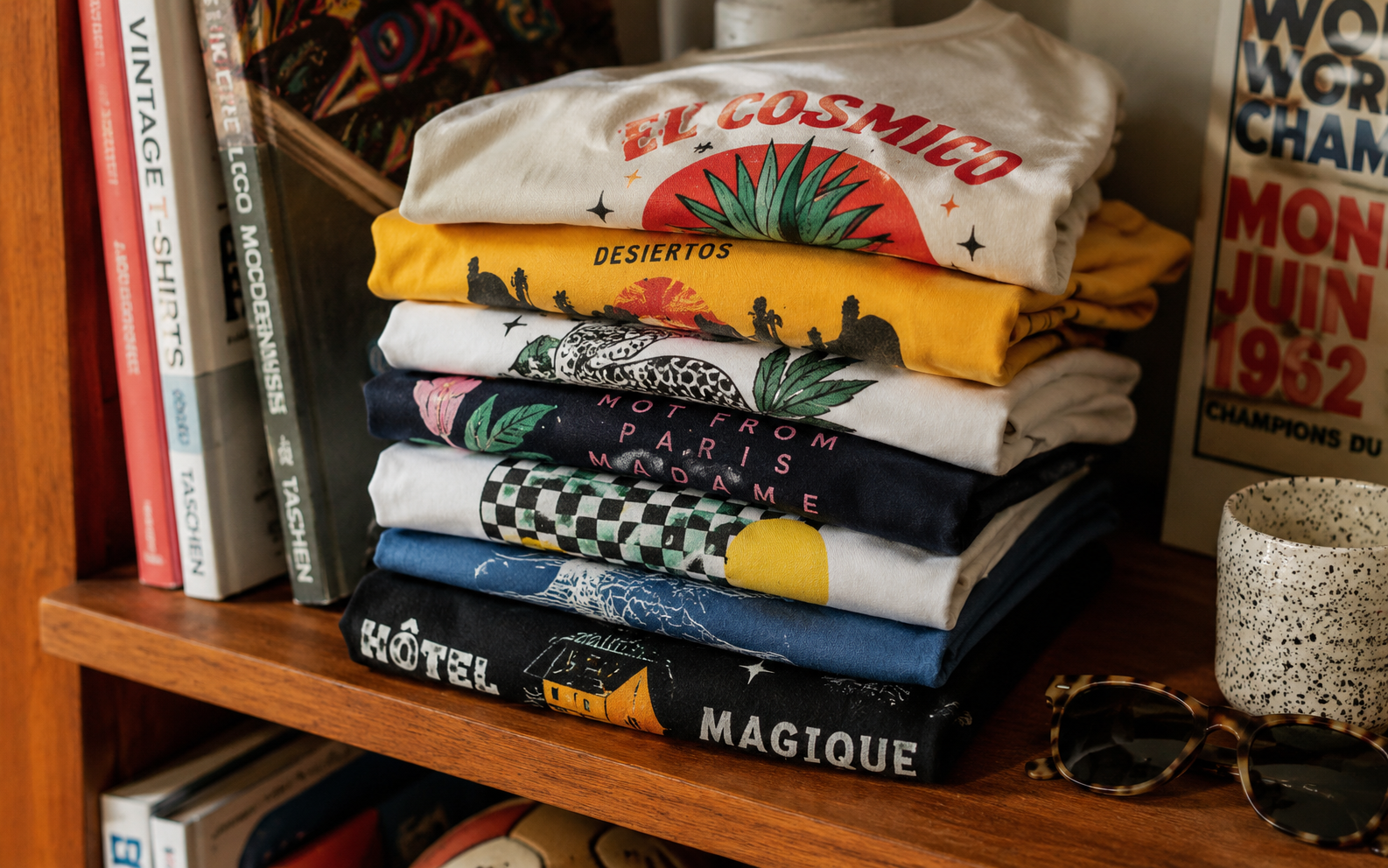
There's a particular kind of person who can't walk past a rack of graphic tees without flipping through every single one. They're not just shopping—they're hunting. For them, a well-designed t-shirt isn't disposable fashion. It's a small piece of visual art you can wear, and it says something about who you are without requiring a single word.
Identity on Cotton
The graphic tee is arguably the most democratic garment in fashion. It crosses every demographic—age, income, subculture. A band tee from a 1994 tour, a limited-run design from an independent illustrator, a vintage promo shirt from a software company that no longer exists. Each one functions as a kind of wearable badge, signalling taste, memory, and belonging.
Collectors understand this instinctively. They're not hoarding fabric. They're curating an identity archive. A 2025 survey by the Fashion Institute found that 41% of graphic tee collectors say their collection tells the story of their life better than any photo album could. That's a powerful statement about a garment you can buy for under twenty pounds.
Design That Resonates
Not all graphic tees are created equal, and serious collectors know the difference. The shirts that hold value—both sentimental and monetary—tend to share certain qualities. Strong composition. Limited colour palettes. Typography that complements rather than competes with the illustration. A design that works at arm's length and up close.
The best graphic tee designers treat the medium like a canvas with constraints. You've got roughly a 30cm square printing area, a limited number of colours if you're screen printing, and a surface that wrinkles and moves. Designing for that requires a different skill set than designing for paper or screen. The constraint, as always, breeds creativity.
The Vintage Premium
Vintage graphic tees have become genuine collectibles. A deadstock Metallica shirt from 1988 can fetch over $1,000 at auction. Even more modest vintage finds—a faded 1990s Disney promo tee, a forgotten skateboard brand design—regularly sell for £40-80 at markets and online resale platforms.
What drives these prices isn't just scarcity. It's authenticity. Vintage tees carry the patina of age—faded prints, soft cotton, cracked ink. These imperfections signal that a shirt has lived, and collectors prize that quality over the crispness of a reproduction. Brands like Hanes and Fruit of the Loom have even launched "heritage" lines trying to recreate that vintage feel, with mixed success.
More Than Just a Shirt
The graphic tee collection phenomenon reveals something broader about how people relate to design. In a world saturated with visual content, the objects we choose to carry on our bodies matter more, not less. A well-chosen graphic tee is a conversation starter, a mood setter, and a micro-statement of creative taste all at once.
For collectors, every tee in the drawer represents a moment—a concert attended, a city visited, a small brand discovered before anyone else noticed. That's not frivolous consumption. It's fashion as memoir, one cotton rectangle at a time.